
Online reviews help report a garage door scam by documenting the exact experience, supporting formal complaints, and warning other homeowners before they hire the same company. A detailed account posted after a bad garage door repair job gives consumer protection groups something concrete to act on.
Scammers rely on victims staying quiet out of frustration or embarrassment after getting overcharged, especially when the amount lost feels too small to pursue further. Filing a review or complaint closes that gap, converting one bad experience into a record that protects the next homeowner from the same company and its tactics.
Key Takeaways
- A detailed review documents the scam for future homeowners to see
- The Better Business Bureau accepts complaints backed by written reviews
- Consumer protection agencies rely on review evidence during investigations
- State licensing boards can act on complaints tied to unlicensed work
- Local homeowner groups spread warnings faster than a single review alone
How Reviews Help Homeowners Report a Garage Door Scam
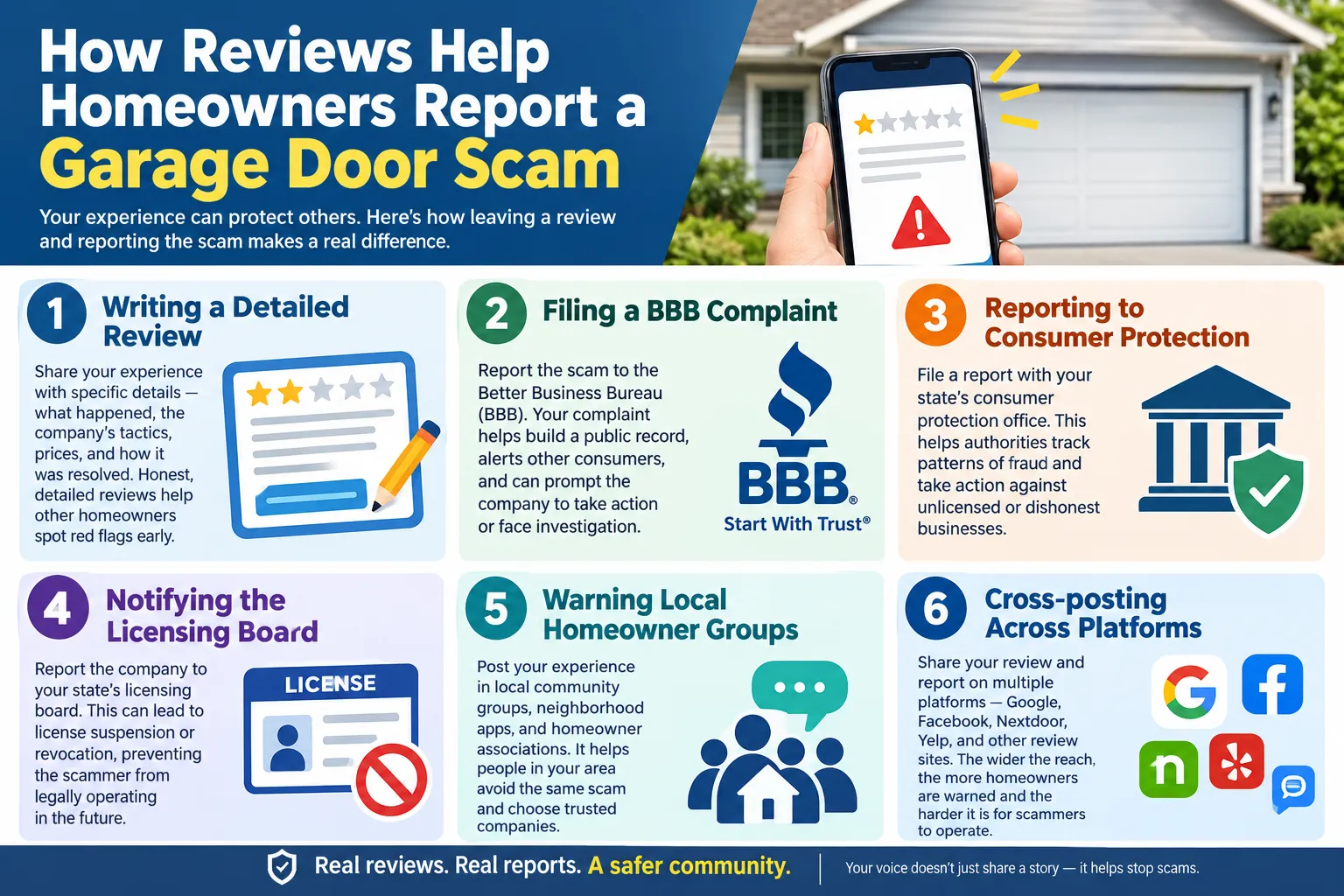
Reviews support several distinct actions a homeowner can take when formally reporting a garage door scam to the right authority.
Reporting Step | Where to Do It | What It Accomplishes |
Writing a detailed review | Google, Yelp, or industry sites | Creates a public, searchable record |
Filing a BBB complaint | Better Business Bureau website | Adds to the company’s formal complaint history |
Reporting to consumer protection | State or federal agency | Triggers a possible investigation |
Notifying the licensing board | State licensing board | Flags unlicensed or improper work |
Warning local homeowner groups | Community forums or social media | Spreads the warning locally and quickly |
Cross-posting across platforms | Multiple review sites | Prevents the company from hiding behind one platform |
A report becomes significantly stronger once it reaches multiple channels instead of stopping after the first complaint gets filed with one agency.
Writing a Detailed Review of a Bad Experience
A review carries more weight once it includes specific facts instead of general frustration about a garage door repair scam.
Specific details help a review succeed by:
- Confirming the exact date and location, ruling out a vague claim
- Naming the technician, helping others recognize the same crew later
- Comparing the quote to the final invoice, proving a bait-and-switch pattern
- Naming a specific part replaced, such as a garage door spring or opener, showing real knowledge of the actual job
- Including photos of paperwork, giving the claim visible, checkable proof
To understand the full picture of how a review like this fits into a larger prevention strategy, read our guide on How Do Online Reviews Help Prevent Garage Door Fraud, which explains the mechanism behind the entire screening process.
Using a Review to Support a Better Business Bureau Complaint
A written review adds credibility to a Better Business Bureau complaint by giving the case specific, documented facts to reference.
A review strengthens a BBB complaint by:
- Linking the review directly, adding independent evidence outside the complaint itself
- Matching dates and details across both, confirming the account stays consistent
- Attaching the original estimate, proving exactly how the price changed later
- Reporting the fraudulent business directly to Google and the BBB, putting the case on record twice
- Requesting a formal response, which forces the company toward public accountability
Filing a complaint this way gives the Better Business Bureau a stronger, better-documented case to act on.
Citing Review Evidence in a Consumer Protection Report
A consumer protection agency moves faster on a report backed by a review than one relying on a single verbal account.
Review evidence strengthens this kind of report by:
- Providing a screenshot, anchoring the complaint to a real public source
- Matching the posting date to the incident, confirming the timeline actually holds
- Pointing to similar complaints in other reviews, revealing a repeated pattern
- Documenting fees that appeared only after the visit began, confirming the exact charges involved
- Preserving the agency’s file number, keeping the case traceable going forward
To find the specific warning signs a review should include before submitting this kind of report, read our guide on Red Flags to Look for in Garage Door Reviews, which breaks down what a genuine complaint pattern looks like.
Attaching Reviews to a Licensing Board Complaint
A licensing board investigates faster once a complaint includes a review documenting proper licensing concerns or unlicensed work.
A review supports this type of complaint by:
- Confirming whether the company holds an active license, establishing the core issue
- Serving as supporting evidence the board can check beyond a verbal claim
- Documenting a proof of insurance dispute, flagging a second, separate violation
- Naming the technician directly, tying the complaint to a specific service, such as a garage door opener repair job
- Holding up over time, so a homeowner can follow up once regulations allow
A licensing board complaint backed by a review carries far more weight than a report with no documentation attached.
Sharing a Review Directly With Local Homeowner Groups
Sharing a review directly in a local community group reaches homeowners faster than waiting for search engines to surface it.
A shared review helps a community by:
- Posting the link directly, putting the warning in front of neighbors immediately
- Naming the company clearly, helping neighbors recognize it before they call
- Adding a short summary, making the warning useful to someone in a hurry
- Encouraging others to share their own experience, revealing the true scope of the issue
- Reaching local moderators, keeping the warning visible for longer
Warning neighbors directly through these groups often spreads faster than a single online review sitting alone.
Cross-Posting a Warning Review Across Multiple Platforms
Posting the same warning across several platforms prevents a repair company from hiding a poor reputation behind one clean profile.
Cross-posting helps a warning succeed by:
- Repeating the same core details everywhere, keeping the story fully consistent
- Varying the wording slightly, avoiding an automated or copy-pasted appearance
- Aligning dates and facts across posts, strengthening credibility on every platform
- Using each platform’s full detail allowance, telling the complete story every time
- Checking back periodically, revealing whether the company ever responds publicly
To learn how to confirm whether a review claiming to expose this same company is genuine before sharing it further, read our guide on How to Identify a Fake Garage Door Review, which explains how to separate real warnings from fabricated ones.
What Comes After Reporting a Garage Door Scam
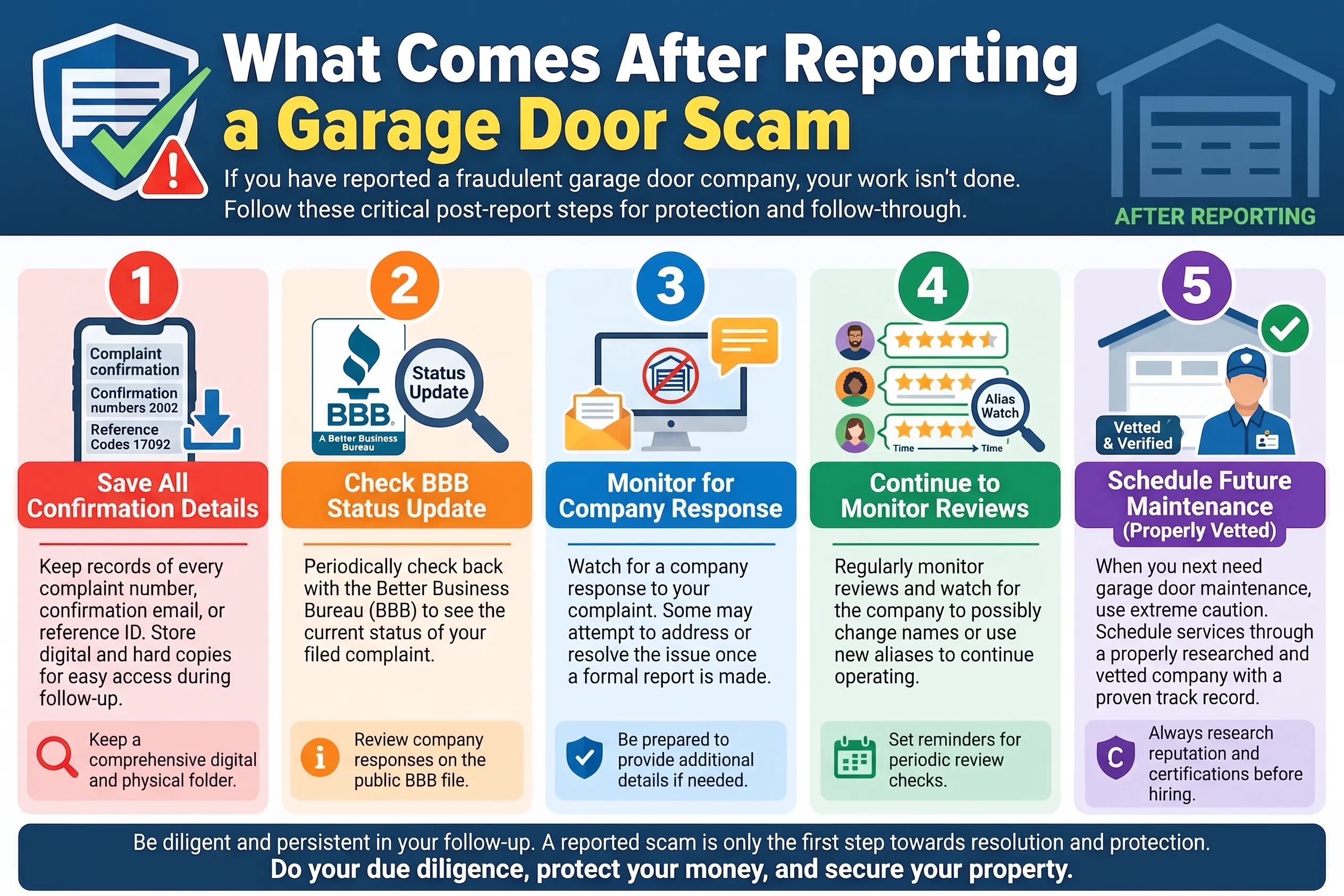
Filing a complaint rarely resolves things immediately, so knowing what to expect helps you manage the wait.
Steps worth taking after a report is filed include:
- Saving a copy of every complaint number or confirmation received
- Checking back with the Better Business Bureau for a status update
- Watching for a company response addressing the original complaint
- Continuing to monitor reviews in case the company changes names
- Scheduling garage door maintenance through a properly vetted company next time
Following up periodically after filing keeps pressure on the company and helps track whether the issue gets resolved.
A Detailed Report Protects Every Homeowner Who Reads It Next
Filing a review or formal complaint changes a frustrating experience into a warning that protects someone else from the same company and its tactics. The extra effort spent documenting a scam carries value well beyond the original situation, often shaping how the next homeowner decides who to hire.
Affordable Garage Door Repairs of Indianapolis, LLC stands behind every completed job across Indianapolis, IN, with transparent pricing that never requires a customer to file a complaint afterward. Contact us or give us a call today, and let our team show what a fully accountable repair looks like from the first call to the final invoice.